
The children categorise food and describe healthy diets.
07 mars 2025
|Recursos para el aula Infantil Primaria Zona de Profes · ELT
Explore food origins, balanced diets and healthy eating habits with your pupils!
Help your pupils practice the present simple tense, expressions of frequency and food vocabulary using days of the week and time expressions.
Introduction
- Write the alphabet on the board and go through the letters. Write food on the board. Choose a letter and encourage the children to name food or drinks which begin with that letter, eg A: apple; B: biscuit, bread, banana; S: spaghetti, salad, etc.
- Ask the children which kinds of food they like/don’t like.
Completing Food: A healthy diet Worksheet 1
Activity 1
- Draw two columns on the board: 1 Food from animals. 2 Food from plants.Say meat and/or show the children the flashcard of meat and ask Animal or plant? Does meat come from animals or plants? Meat comes from animals.Write meat in column 1. Do one or two more examples asking Do vegetables come from animals or plants? Encourage the children to make complete answers if possible, eg Vegetables come from plants.
- Children complete the table in Activity 1. Check their answers by asking questions as above.
Answers: Food from animals: meat, cheese, fish chicken, yoghurt, eggs, milk; food from plants: vegetables, spaghetti, fruit, beans, bread, rice.
Extra activity
Get the children to write one or two more words in each column and then to test each other, eg Child 1: Eggs? Child 2: Animals. Fruit? Child 1:Plants.
Activity 2
- Explain in L1 or L2 that some food is good for us and some food is not very good. Show the class one of the pictures of food and ask if this food is good for you, eg What’s this? An apple! Yes, it’s an apple. Are apples good for you?(with happy face) Or OK? (expressing doubt). When a child says Good! sayYes, apples are good for you! Continue with other types of food. Use Good orOK, eg Vegetables are good for you. Ice cream is OK. Pizza is OK. Bread is good for you. Explain in L1 or L2 that ice cream and pizza are OK if we eat them one or two days a week. If we eat them every day they are bad for us. Fruit is good for us and we should eat fruit every day.
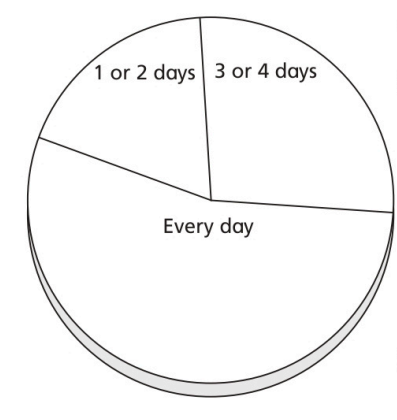
- Write A healthy diet on the board and draw a diagram like the one in Activity 2. Write every day, 3 or 4 days and 1 or 2 days in the three sections. If you have a picture of a doctor or a nurse show it to the children and put it up on the board and explain that we are going to talk about a good, healthy diet. Say Cakes! Seven days? Three or four days? One or two days a week? and point to the doctor or to the title ‘A healthy diet’. Cakes? (pause) One or two days a week. Fruit? How many days a week? Seven. Chocolate? One or two days a week. Milk? Seven days a week/every day. Explain that every day = seven days a week. Meat or fish? Every day. Vegetables? Every day, etc. Write the foods in the appropriate sections of the diagram.
- Ask the children to write the names of the different types of food in Activity 2 in the right places in the diagram. They can then compare answers in L1 or L2.
Answers: One or two days: chocolate, cakes; three or four days: eggs, pasta or rice; Every day: fruit, vegetables, milk, meat or fish, water.
Advantage users have access to the full resource.
¿Eres profe y utilizas un método Macmillan Education? ¡Descubre más recursos como este en Advantage!